

























|
|
|
|
|
|
|
|
|
|
|
|
|
|
|
|
|
|
|
|
| |||||||||||||
|
|
|
|
| ||||||||||||
|
| |||||||||||||||
|
|
| ||||||||||||||
|
|
|
| |||||||||||||
|
| |||||||||||||||
|
|
| ||||||||||||||
|
| |||||||||||||||
|
|
| ||||||||||||||
|
|
|
|
|
|
|
|
|
|
| ||||||
Super Absorbent Polymer
Super Absorbent Polymers (SAP) are very unique water-absorbing and water-holding materials. They can absorb up to 1000 times of their own weight of pure water and even under pressure resist release of the absorbed water.
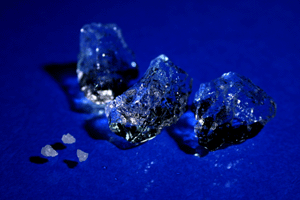
They are solid, granular or powder cross linked polymers that rapidly absorb and retain large volumes of aqueous solutions. The absorptive properties of SAP are ideally suited for the absorption and solidification of various types of liquids like water, sludge, blood etc.Before (left) and after (right) adding water to SAP
History of SAP Superabsorbent polymers were first introduced by Union Carbide in the mid 60's. They were first developed in the 70's to grow plants in the desert. However, they were used very little by commercial growers due to their relatively high cost in comparison to their swell capacity. In the early 80's, superabsorbents began to be widely developed for the baby diaper market (hundred of millions of pounds). This led to newer, higher swell polymers, some with long lasting life that were suitable for agriculture and water treatment management. Nowadays SAP has lots of applications in different industries form baby diaper to fire fighter and craft industries.
Science Behind SAP The driving forces behind a superabsorbent polymer's water absorbency are osmotic pressure and hydrogen bonding. The difference in the sodium ion concentration between the inside of the polymer and the solution in which it is immersed causes the water to flow in rapidly, trying to balance the number of ions inside and outside the polymer. Also, the polymer chains are lined with carboxyl groups (-COOH) with about 50 to 70% of these in the sodium salt form. In contact with water, the carboxyl groups dissociate into negatively charged carboxylate ions (-COO-). These form hydrogen bonds with water molecules.
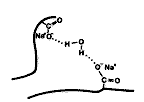
Figure 1
In addition, these carboxylate sites repel each other, which widens the polymer network, thus allowing more water to be absorbed. However, the crosslinked polymer molecules can only stretch so far. Therefore, the amount of water absorbed is in part determined by the balance between widening of the polymer network as hydrogen bonds form and "elastic pressure" of the crosslinked molecules.
The electrolyte concentration in the water being absorbed greatly affects the amount of fluid that can be absorbed by the polymer. The ions of the electrolyte act as "contaminator" ions and become positioned along the polymer chain at the carboxylate sites. The electrolyte ions partially neutralize these sites and limit the potential sites for hydrogen bond formation between the polymer and water molecules. In addition, there will be less repulsion between the crosslinked chains of the polymer, thus enabling less water to be absorbed. Also, the presence of these ions decreases the unbalance which "drives" osmotic pressure.
A typical superabsorbent polymer may absorb about 400 times its own mass of distilled water while absorbing almost 300 times its mass of tap water. The same polymer may absorb only 30 to 40 times its mass of 1% sodium chloride solution.
Types of SAP There are two general types of SAP, the acrylate and acrylamide .The cross linked acrylate SAP is a non toxic polymer which can be produced in sodium or potassium acrylate bases .The cross linked acrylamide SAP is a synthetic potassium-based, neurotoxin, long-chain polymer designed to attract either positively charged particles (organic materials, such as carbon or human waste) or negatively charged particles (inert materials, such as sand or clay).
Polyacrylamide was developed in the 60’s to grow plants in the desert and has been refined to last longer and absorb water at higher rates. Many people believe polyacrylamide is the active material in baby diapers, but that polymer is polyacrylate, which is a close cousin in the polymer family. Polyacrylate is capable of absorbing greater amounts of liquid than polyacrylamide, but rapidly breaks down.
|
Home | SAP Application | Products | Order | Private Label | FAQ | About Us | Contact Us Copyright © 2005 Canadian Golden Pak,
Ltd. info@goldenpak.com |